|

|
Emotional Message of Compositional Lines and Colors, Sketches Vincent Van Gogh The
Starry Night 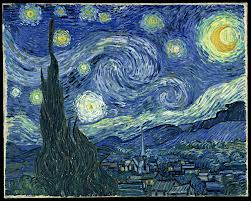 The “Starry Night” was painted by Vincent van Gogh in Summer, 1889 during his stay in the San Deny hospital. During this many month long stay in hospital’s asylum, he created several emotional, expressive paintings. These artworks belong to his last artistic period indicated by the expressive pastose brushstrokes which function almost like the compositional lines. The Starry Night is one of van Gogh’s major masterpieces created during this period. The Museum of Modern Art, NY is the proud owner of this masterpiece. However, van Gogh himself didn’t like The Starry Night and didn’t consider this painting as one of his best. In the letter to his brother, Theo, he asks to exhibit another painting under the same title The Starry Night (The Starry Night over Rhone) which he considered to be more conventional. In his opinion, most of the paintings created in hospital were “too mad”. [1] Despite van Gogh’s own opinion, The Starry Night is one of the most popular paintings in the art history. The key to its popularity is based on Van Gohg’s strongly expressed message of hope and faith. Any viewer can relate this painting to his/ her own situation and interpret it differently. The turbulent meaningful composition combined with the perfect harmony of complementary colors may explain the enormous popularity of this masterwork. The composition of The Starry Night expresses a variety of different feelings: sadness; being trapped; hope and even excitement. The sliding line of the landscape expresses the falling into sadness. This sliding thick wavy contour line of the mountain chain at the horizon starts almost in the middle of the right side of picture plain and goes down to the left of the painting. All the brushstrokes modeling the mountains ornamentally repeat this sliding down movement. The bright yellow strip on the sky repeats the wavy mountain contour signifying the expressive importance of this ‘sliding down’ landscape.  The small houses in the village at the bottom-right of the landscape are painted like a few small stable triangles and squares. They provide a feeling of stability contrasting the turbulence of the landscape contours. The thin tall church tower is just slightly touching the sky. It is not high enough to reach the heavens. The trees surrounding the village are painted with the wavy brushstrokes resembling the ocean waves. The sliding brushstrokes of the landscape with wavy brushstrokes of the trees are directed toward the village. This village in the landscape looks like the calm island attacked by the high waves of the stormy ocean. The dark cypress at the left side of the painting builds a vertical line from the bottom side of the picture to the upper edge. The cypress strongly interrupts the sliding down movement and elevates the eye of the viewer from the horizontal sliding path of the landscape into the sky. The sharp triangle of the cypress resembles the flame striving up like the Gothic cathedral. The small church tower parallels this vertical movement signifying the importance of this movement and the relationship between the church tower and the cypress. In addition, the cypress and church tower mark the axel from upper left to the bottom right, thus proving some balance to the sliding landscape lines. In the middle of the sky are mysterious bright spiral strips. The stars ornamentally framing this strips support the spiral movement. The eye of the viewer, following the spiral movement ends in the center of the sky without continuation of the compositional line. The viewer is trapped. There is no way out of this circling movement in the sky. The eye can repeat the circling over and over again without leaving the heavens. This mysterious play of the heavens appears to be the dominating element of the composition. We are trapped in this dynamic fascinating movement of the mysterious heavens and stars. The big bright moon is located on the upper right corner of the picture plain. The moon is separated from the spiral movement of the stars, as a witness watching with us this heavenly play.
The comparison with other van Gogh’s paintings created in the hospital’s asylum during this period
of his life may provide the genesis and meaning of the mysterious bright spirals in the sky. He painted several landscapes
as viewed from the hospital’s garden. They show common element- the sliding line of the landscape from right to left,
similar to The Starry Night. Especially should be noted The Mountain Landscape Seen across the Walls.
The artist tried to balance the sliding landscape lines by painting turbulent wavy clouds on the left side
of the sky. These clouds resemble the sky-spirals of The Starry Night. During the same period, in summer 1889, he
created several painting, showing the different positions of the tall cypress in his compositions. The
problem of balancing the sliding landscape with the sky; and the search for the precise function of the tall cypress in such
composition may be seen as the key to composition of The Starry Night. This masterwork can be seen as artist’s
double victory: he found the solution for the perfect balance of the complicated meaningful composition, by liberating himself
from the domination of the landscape’s sadness. The perfect harmony is expressed in the palette- the color combination of this painting. All the hues are strictly complementary. There are no contradictions or dissonance. The blue and violet of the sky and landscape are complimented by the yellow and yellow orange. The dark bluish green cypress is complemented by the reddish orange. While the compositional lines suggest to leave the sliding stormy earth and to watch the mystery of the heavens, the colors provide a feeling of the perfect harmony, expressing the positive message of this artwork. There is no pessimism present in this composition and colors: it expresses comfort and faith in sad difficult situation. Anyone can interpret this message in subjective, personal manner. Therefore the message of this picture may be seen as universal. End Note [1] Stein, Susan Alyson, Ed. Van Gogh A Retrospective. NY: Hugh Levin, 1986, p.156

|
